Climate change continues to turn up the volume on food insecurity across vulnerable communities worldwide. It is also making crop yields less predictable using traditional estimation methods. A new modeling framework, called GEO-CropSim, creates a concerto including water use, agriculture management decisions, and climate — and adds in overtures of satellite data to fill in gaps. This hybrid composition gives decision-makers an early warning on areas struggling with production.
GEO-CropSim was developed in a collaboration between the USDA's Agricultural Research Center, the University of Maryland’s Department of Geography, and NASA (National Aeronautics and Space Administration) Harvest, the model uses a combination of biophysical and meteorological input data to estimate crop yields.
One part of the hybrid approach combines climate and soil data with management decisions, like fertilizer use, to simulate crop growth in a series of timesteps. This type of model tends to be very accurate — when data are available. But they frequently suffer from data gaps at necessary scales. The other part of the model includes remote sensing data. Earth-observing satellites monitor crops from space. These data are then used to estimate different crop characteristics, like leaf area index, land surface temperature, or water content within leaves. Remote sensing models have a wealth of information and cut down on field monitoring costs but tend to be trained with narrow parameters and encounter issues in areas different from their training location.
By combining the two models, GEO-CropSim leans on the strengths of each model type while helping to overcome their limitations. The tool expands on a highly successful process-based model called Environmental Policy Integrated Climate (EPIC) by using remote sensing data for both leaf area index and crop emergency dates.
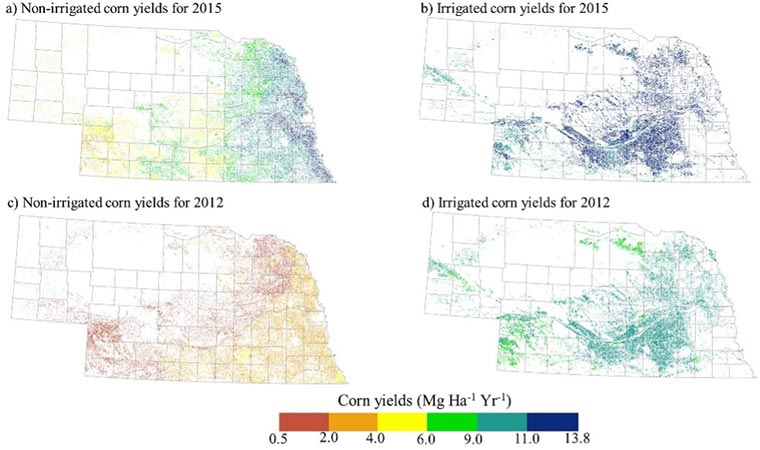
The GEO-CropSim team tested their model at three locations in Nebraska for both maize and soybean fields. They wanted to evaluate how the model would work in different growing conditions, so they used data from one drought year (2012) and a non-drought year (2015). After modeling predicted yields for the state in both years, the estimates were compared to historical yield data and Evapotranspiration (ET) observations from the USDA’s National Agricultural Statistics Service. CropSim was found to produce a higher “granularity” or more specific results across the study sites than the original EPIC model.
In the hands of end users, GEO-CropSim gives advanced warning of low potential yields and allows farmers and policymakers to evaluate the effectiveness of different management strategies. It is a valuable decision-making tool that helps monitor and improve crop production while simultaneously analyzing water consumption.