On January 16, 1968, a researcher climbed up to Colorado’s Niwot Ridge on the doorstep of the Indian Peaks mountain range to get some air—literally. The researcher carried an air sample down from 11,568 feet above sea level and then measured how much carbon dioxide it contained at a lab in Boulder, Colorado. The result: 322.4 parts per million. Though NOAA was not officially established until 1970, this air sample produced the first measurement for the agency’s Global Greenhouse Gas Reference Network (GGGRN).
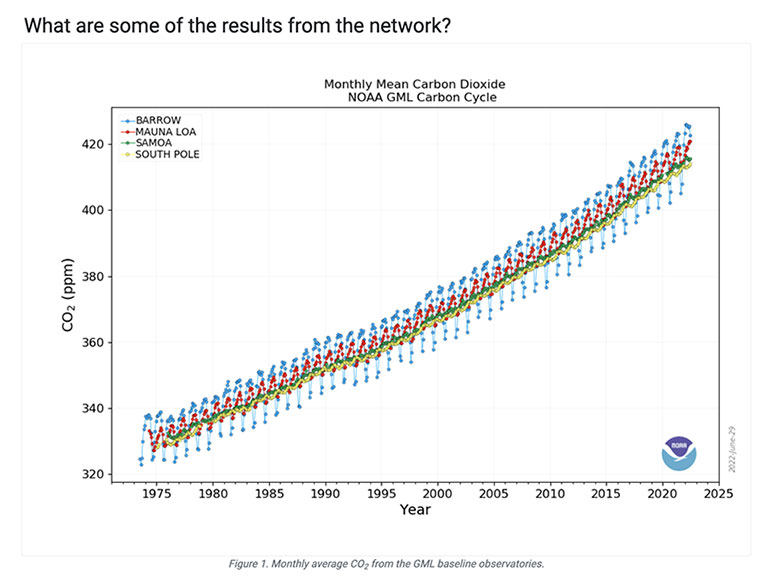
In the decades since, carbon emissions have climbed. The global average for carbon dioxide in the atmosphere is now over 420 parts per million. And the GGRN continues to take the pulse of the planet. More than 300,000 air samples have been collected at over 60 sites around the world. The result is a long, uninterrupted, and highly accurate accounting of Earth’s changing atmosphere. In fact, the GGGRN database is the third-longest continuous carbon dioxide record in the world.
Samples are transported to NOAA’s Global Monitoring Division labs in Boulder. Researchers there analyze the samples for carbon cycle gases. These are the main long-term drivers of climate change, and they include carbon dioxide, methane, and carbon monoxide. Over the years measurements have been refined and added. Now samples are analyzed for about 55 different trace gases, some at a resolution of parts per trillion.
Collectors take air samples on a weekly basis at a variety of locations, from the Alaskan Arctic to the South Pole. The sample collectors may be just as diverse as the monitoring sites. They have included not just scientists and technicians, but also soldiers, ranchers, mariners, schoolteachers, lighthouse keepers, and a monk.
The GGGRN has become one of the most valuable resources for the international climate science community. While collection and measurement methods have changed over time, the historical data is still reliable and used by researchers.