Desert locust swarms can lay waste to entire fields of crops at an alarming rate. When they descend upon new territory, they fill the air in densely packed swarms and cause severe damage. A small swarm, spanning one square kilometer, can consume the same amount of food as 35,000 people in a single day. Locust swarms leave a barren wasteland in their wake, contributing to food insecurity across Africa and the Middle East.
When locust swarms began wreaking havoc in eastern Africa in 2019, the United Nations Food and Agriculture Organization sounded an urgent alarm and requested a way to better forecast this migratory pest’s movement. The swarms that year were some of the worst in a quarter century, making early detection especially vital. To answer the call, scientists adapted a powerful air quality model that was previously used to track the movement of pollution from wildfires, volcanoes, and industrial accidents. Now this model is used to provide a locust swarm early warning system across Africa and Asia.
This atmospheric transport tool, called HYSPLIT, uses meteorological forecast data from the National Weather Service to predict the most likely paths of locust movement in the air — and even factors in the time locusts spend landing to rest each day. The forecasts generated by this tool enabled the U.N.’s Food and Agriculture Organization to issue warnings about a second wave of swarms. These warnings gave local officials enough time to plan and prepare mitigation resources, like aerial spraying equipment, to reduce the impact of swarms once they arrived.
“We hope this new tool will help response organizations reduce the devastation that’s being wrought by these locust swarms,” said Mark Cohen of NOAA’s Air Resources Laboratory, who co-led the NOAA effort to develop the application with the U.N.’s Food and Agriculture Organization.
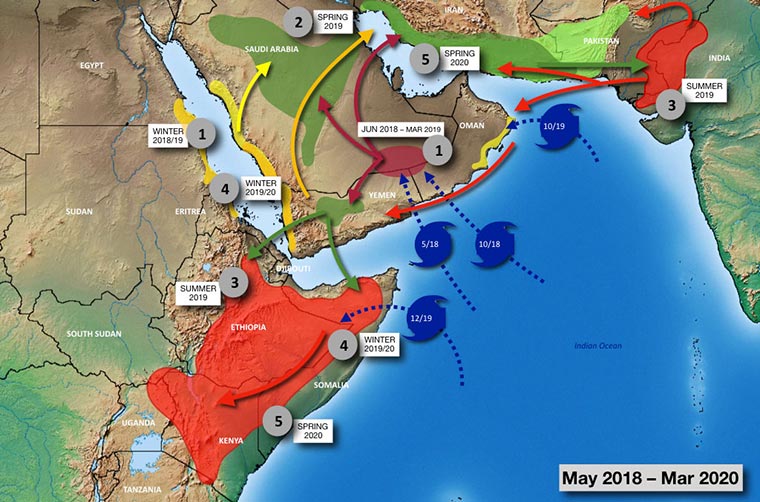
Development of this new tool occurred very rapidly. In February 2020, Keith Cressman, a senior locust forecasting officer at the United Nations Food and Agriculture Organization, reached out to NOAA with a request to refine HYSPLIT to produce more accurate and efficient locust predictions. He was running the model several times a day and sought a way to produce faster forecasts for countries desperate for information. The NOAA scientists realized that to do this, they needed to account for locusts’ behavior.
“We realized this was a huge problem and we absolutely wanted to help in any way we could,” said Sonny Zinn, a software engineer at NOAA’s Air Resources Laboratory, who co-led the effort to quickly develop a user friendly, web-based application using the powerhouse HYSPLIT model at its core.
Within a few weeks, Cohen and Zinn created the web application which now supports the U.N.’s operational forecasts. Wind data are key to forecasting because desert locusts are passive fliers that drift with the wind. Using data on wind speed and direction from NOAA’s National Weather Service global weather forecast model allows for accurate predictions of where the locusts are likely to go and when. The new application can also be used to indicate potential source areas of desert locust swarms.
To make the new tool even more useful, NOAA created a system that enables Cressman and others to easily run forecasts for multiple swarms all at once. The model also accounts for the times of day when locusts are most likely to fly. Cressman praised how quickly the NOAA team developed the locust trajectory model.
“This has really improved our ability to assess the desert locust situation and forecast its developments globally,” Cressman said. “This is vital to the affected countries for better planning and implementation of the necessary control operations on time.”
NOAA plans to continue collaborating with the U.N.’s Food and Agriculture Organization to enhance the model. “As we get more information on the science of how they fly, how high they fly, we will be able to make the tool even more accurate,” said Zinn.