As Ecuador’s Azuay Province continues to lose many of its men to emigration, a chorus of women have risen up to ensure the wellbeing of the community. The mothers, daughters, and sisters left behind have lent their voices — and their strength — to initiate, design, and build an irrigation system that will help them continue feeding their families.
That’s no small feat considering less than 40% of Azuay’s population of 882,000 have regular access to water. The province experiences frequent droughts and irrigation is sparse, posing serious challenges to agriculture. Climate change is projected to exacerbate these issues. Initiated in 2021, this woman-led project aims to overcome some of these challenges by using Earth observation data to chart the best path for an irrigation system called Cerro Negro.
Nestled in the country’s highlands, the Azuay area serves as a critical water source for downstream communities. However, the community’s mountainous terrain makes it challenging to capture and distribute enough water to its inhabitants. Construction is difficult, and the two available water catchments are located in remote areas 3100 meters above sea level.
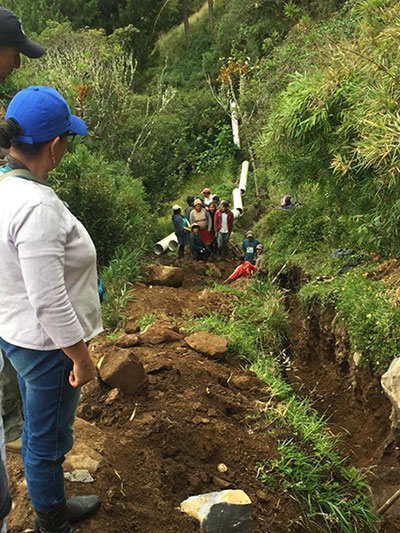
The lack of streamflow data information compounds the water shortage issue. The entire country of Ecuador has only 34 water gauge stations, and very few of them are located in Azuay. This complex set of circumstances led Azuay’s local officials to seek an innovative solution. They consulted the historical streamflow and water level data from the NASA/USAID-supported GEO Global Water Sustainability (GEOGloWS) European Centre for Medium-Range Weather Forecasts service. They then worked with Ecuador’s national hydrometeorological agency—the National Institute of Meteorology and Hydrology (INAMHI in Spanish)—to tailor that information to their locale.
Using these data, the Azuay community determined the best design and placement for two siphons in the irrigation system. Once these important decisions were in place, a primarily female crew began to build the irrigation system.
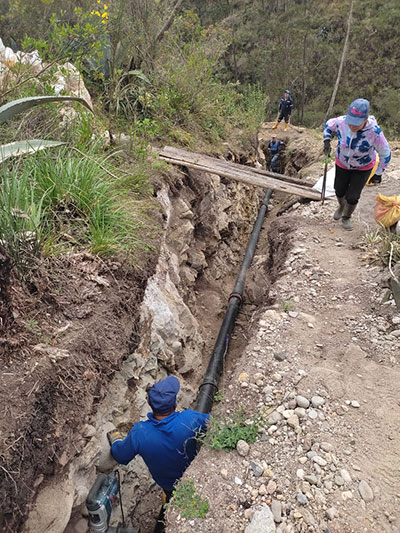
Projected to be complete in 2024, the Cerro Negro pipeline will span 38 km and irrigate an area of 500 hectares. Estimates indicate it will benefit more than 5,000 people directly and 10,000 people indirectly. Most of the water from this project will be used to provide water to crops and livestock, which will enhance the community’s food production and sustainability.