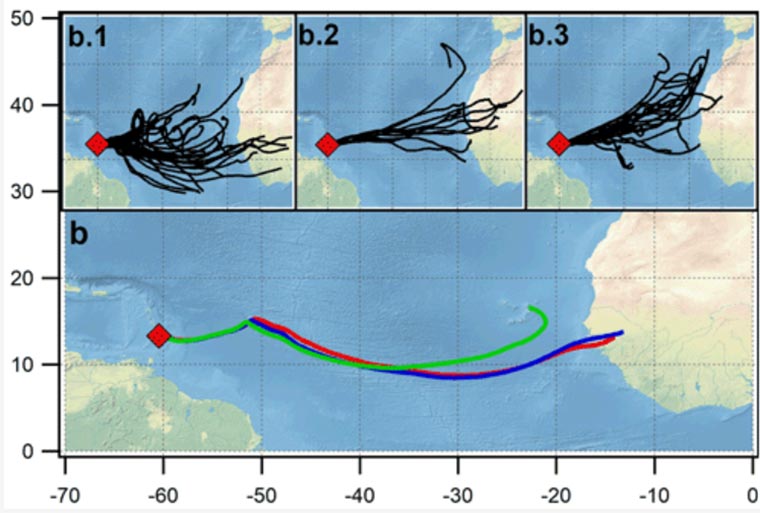
Few studies have attempted to fully understand whether particles like smoke are a prominent source of cloud formation year-round. Observations from a recent NOAA/NASA field campaign and its European counterpart revealed three events in which smoke particles from Africa traveled to Barbados and influenced cloud formation. Scientists funded by NOAA developed a specific parameter to include in climate models that represents the way smoke can create clouds.
Scientists want to understand the properties of cloud-forming aerosols as they are the key to understanding the effect of clouds on radiative forcing. Radiative forcing is the change in atmospheric energy flux that causes heating or cooling. Scientists still have trouble predicting the effect of aerosols on these energy changes. This leads to more uncertainty in predicting temperature increases linked to climate change.
Aerosol-cloud interactions are especially important to study over the oceans, which cover most of Earth's surface. Few studies have attempted to fully understand whether aerosols like smoke particles help seed clouds year-round. This campaign occurred in the winter, but most earlier studies occurred in the summer. These winter results showed unexpected periods of long-range transport of smoke particles, along with dust, from Africa to Barbados. Previous work in the past decade had identified Barbados as a dust receptor site. But the role of smoke had not been the focus of research on atmosphere and cloud processes. The findings were published in January 2023 in Atmospheric Chemistry and Physics. The new results suggest more research is needed on the link between smoke and cloud formation in the Caribbean and elsewhere.